
1FY24
Performance


Investment environment in 2023–24
Over the past year the world has witnessed a further meaningful shift in geopolitical dynamics. Escalating tensions, particularly war in the Middle East as well as the ongoing Russia-Ukraine war, have underscored the fragility of global peace. US-China relations continue to evolve and are a testament to the growing emphasis on national security and protectionist policies.
Meanwhile, what we describe as the ‘New Investment Order’ thematics demonstrated further momentum, with disruptions to global trade and commerce, increased friendshoring or reshoring of capital, and increased defence spending. Elections across the globe further catalysed these dynamics, with populist leaders gaining ground.
All that said, there were some positive developments, such as improved dialogues between China, Australia and the US, and the lifting of some restrictions on the export of Australian primary products.
Nonetheless, the geopolitical landscape remains fraught with uncertainties. In our recently published position paper titled Geopolitics – the Bedrock of the New Investment Order, we set out how we define and conceptualise geopolitics, why we think it is so important, and how we incorporate such uncertainties into our investment process.
The cyclical investment backdrop was generally positive over the course of the year.
The global economy, particularly in the US and Australia, was broadly resilient as swift disinflation and tight labour markets provided a tailwind to real incomes which supported consumption along with excess savings.
Inflation continues to moderate towards target across the developed markets complex although the pace of disinflation has slowed meaningfully during this calendar year to date. Goods deflation from supply side normalisation is no longer providing a tailwind and services inflation is proving to be sticky, driven by tight labour markets.
Regional divergences persisted into 2024, with the US economy at or above-trend growth for most of the year and Australia proving resilient overall but somewhat weak on a per capita basis.
Most other developed economies languished, with low growth in the UK, Europe and Canada. While the domestic policy mix and structural economic challenges led to a relatively weak Chinese economy.
More recently, economic conditions in the US have shown signs of easing, although remaining broadly around trend, with inflation also printing more softly. Economic data in the rest of the world may have reached a local minimum, with conditions in China, Europe and the UK improving.
Since July 2023 developed market central banks largely held monetary policy steady at decade-high levels as they assessed the lagged impacts of a rapid policy-tightening cycle.
The steadiness in policy rates masks significant market volatility over the period as expectations for future policy easing swung meaningfully, reverberating through asset prices. Swift US disinflation into December saw significant policy easing priced for 2024, only to see most of that easing priced out by the end of April as inflation re-accelerated over the first quarter.
The People’s Bank of China refrained from stimulating the economy despite weak activity, due to fear of further currency debasement. Fiscal measures have been piecemeal and somewhat underwhelming in aggregate.
The Bank of Japan hiked its policy rate for the first time in 16 years in April, with officials satisfied that cost–push inflation from higher input prices and a weak yen would catalyse a ‘virtuous cycle’ between wages and prices, lifting the Japanese economy out of the ‘lost decades’ of stagnation.
As inflation continued to drift lower into the end of the financial year, several central banks have slowly shifted to easing monetary policy, with the Canadian, European, Swedish and Swiss central banks all lowering interest rates.
In the US, disinflation resumed in April and May as activity data moderated from the very strong levels seen over the prior six months. Services inflation remains uncomfortably high, however, and has only modestly reduced which is likely to limit monetary policy easing in the absence of any meaningful softening in the labour market.
Equity markets, and risk assets more broadly, rallied strongly over the year with the S&P 500 marking several new highs as rapid disinflation and robust US growth buoyed margin estimates and risk sentiment. The expected future productivity benefits of AI provided an additional tailwind to returns as did fiscally supported CapEx initiatives in the US as the re-industrialisation agenda continues.
Commodity markets also reflected the robust growth environment with oil and metals moving meaningfully higher, although relative softness in iron ore prices is likely owing to lacklustre demand from China.
With US elections on the horizon, shifting geopolitical dynamics, monetary policy in flux and an ever-expanding fiscal policy agenda, the economic environment remains uncertain and volatile. The investment environment, however, continues to present ample opportunity for investors.
Year at a glance
The Future Fund is a long-term fund created to strengthen the Commonwealth’s long-term financial position. The Fund’s 10-year return of 8.3% per annum remains above its benchmark target of 6.9% per annum.
The annual return of 9.1% is a strong result and reflects the significant activity to position the portfolio to deliver long-term risk-adjusted returns in alignment with our mandate.
At $224.9 billion the Future Fund is the Commonwealth Government’s largest financial asset, bolstering the Federal Government’s balance sheet and Australia’s credit rating.
The risk positioning for the Future Fund is slightly above neutral, and we will remain vigilant and continue adjusting the portfolio to enhance resilience and ensure it is as robust as possible to a number of plausible scenarios.
Total funds under management
$289.4bn
At 30 June 2024
Future Fund
Drought Fund
$224.9bn
Ready Fund
Investment Performance
Future Fund
The Future Fund was established in April 2006 to strengthen the long-term financial position of the Commonwealth of Australia.
Investment mandate
CPI + 4.0%–5.0% per annum
To achieve an average annual return of at least the Consumer Price Index (CPI) + 4.0% to 5.0% per annum over the long term, with an acceptable but not excessive level of risk.
Investment performance
9.1%
pa return in FY24
$224.9bn
value at 30 June 2024
8.3%
pa 10-year return
6.9%
pa target 10-year return
Note(s):
- From 1 July 2017 the Fund’s Investment Mandate target return was reduced from the CPI + 4.5% to 5.5% pa to the CPI + 4.0% to 5.0% pa over the long term, with an acceptable but not excessive level of risk.
- Industry measure showing the level of realised volatility in the portfolio.
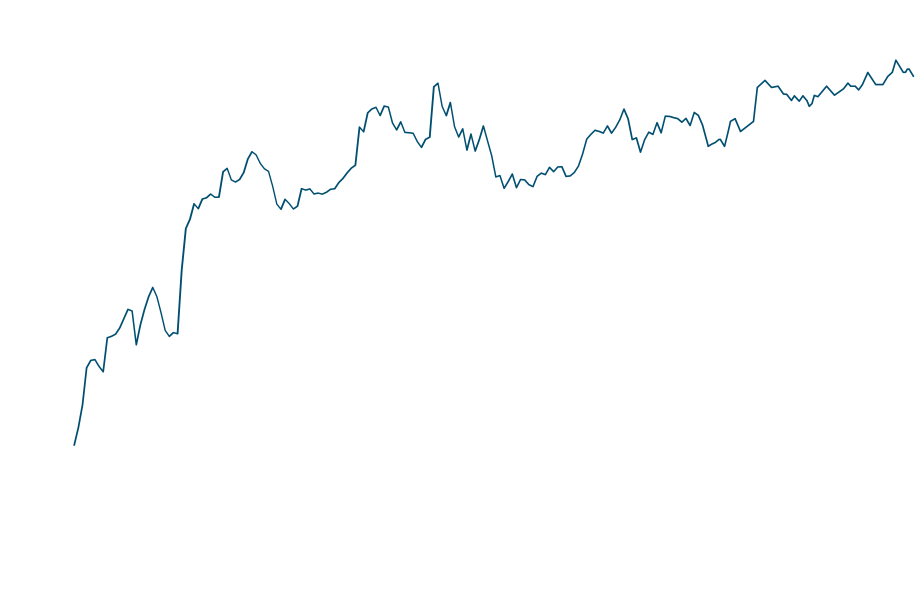
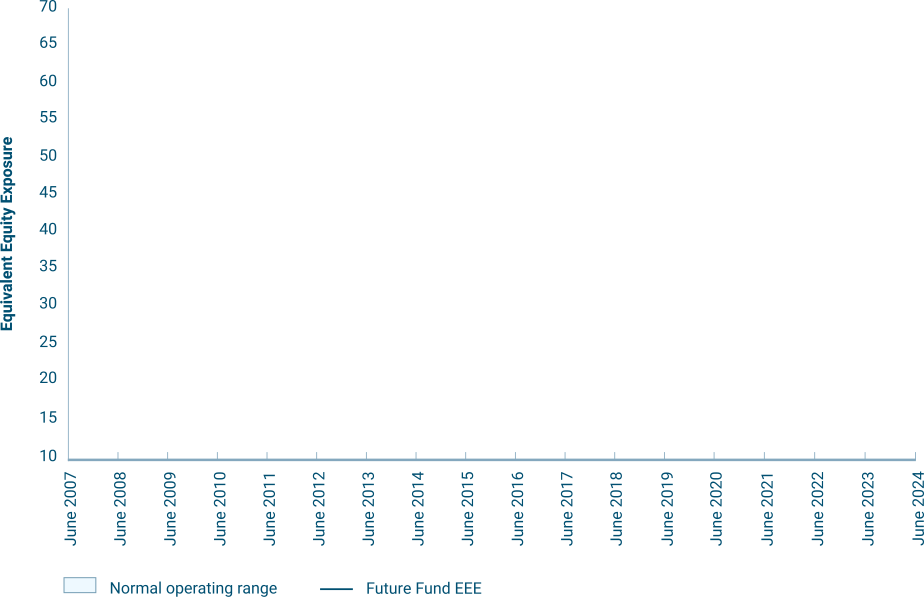
Future Fund Equivalent Equity Exposure since inception


Measuring risk
One of the primary metrics we use to understand and manage the broad market risk exposure of the Future Fund is Equivalent Equity Exposure (EEE). EEE estimates the amount of market exposure we have when looking through the whole portfolio.
The chart above demonstrates how the EEE of the Future Fund has changed over time.
We are currently in the seventh distinct risk-taking regime for the portfolio since establishment:
- The build of the Future Fund portfolio was suspended in late 2007 due to concerns over financial stability and the sustainability of high asset prices, and a very low-risk profile was maintained into the Global Financial Crisis.
- Portfolio risk exposure was increased as extraordinary and globally coordinated economic policies were implemented to fight the crisis.
- Risk levels were raised further as the European crisis subsided and the President of the European Central Bank committed to ‘do whatever it takes’ to underwrite the integrity of the euro.
- As expected returns declined (given strong market performance supported by low interest rates), portfolio risk was gradually reduced to moderately below normal levels.
- Risk levels were increased towards more normal levels, reflecting the emergence of strong economic growth and corporate earnings, and central banks signalling an extension of accommodative monetary policies, together with the decision to increase the Fund’s structural risk appetite.
- Risk levels were reduced to moderately below neutral, reflecting the elevated risk environment resulting from the COVID-19 pandemic and policy response.
- The structural risk level was adjusted during the 2020–21 financial year and we narrowed the range around which we expect to manage the portfolio. Subsequently, EEE is managed reasonably close to neutral structural levels.
Risk positioning
The EEE range within which we are expected to operate most of the time was reviewed and uplifted to 55–65 as part of the recent deep review of our investment strategy. Throughout 2023–24, the portfolio risk setting has averaged close to the middle of the range and at 30 June 2024 the EEE stood at 61.
Medical Research Future Fund
The Medical Research Future Fund was established in 2015 and will improve the health and wellbeing of Australians by providing grants of financial assistance to support medical research and medical innovation.
Investment mandate
RBA + 1.5%–2.0% per annum
To achieve at least the Reserve Bank of Australia cash rate target + 1.5% to 2.0% per annum, net of investment fees, over a rolling 10-year term.
Investment performance
8.4%
pa return in FY24
$23.1bn
value at 30 June 2024
Note(s):
- Industry measure showing the level of realised volatility in the portfolio.
Risk positioning
Our expected EEE range for the Medical Research Future Fund is 27 to 34.
At 30 June 2024, the EEE stood at 32, which is close to the middle of the range.
Aboriginal and Torres Strait Islander Land and Sea Future Fund
The Aboriginal and Torres Strait Islander Land and Sea Future Fund (ATSILS Fund) was established in February 2019 to enhance the Commonwealth’s ability to make payments to the Indigenous Land and Sea Corporation.
Investment mandate
CPI + 2.0%–3.0% per annum
To achieve an average annual return of at least the CPI + 2.0% to 3.0% per annum over the long term, with an acceptable but not excessive level of risk.
Investment performance
9.4%
pa return in FY24
$2.3bn
value at 30 June 2024
Note(s):
- Industry measure showing the level of realised volatility in the portfolio.
Risk positioning
Our expected EEE range for the ATSILS Fund is 36 to 45.
At 30 June 2024, the EEE stood at 41, which is towards the middle of the range.
Future Drought Fund
The Future Drought Fund was established in September 2019 to support initiatives that enhance the drought resilience of Australian farms and communities.
Investment mandate
CPI + 2.0%–3.0% per annum
To achieve an average annual return of at least the CPI + 2.0% to 3.0% per annum over the long term, with an acceptable but not excessive level of risk.
Investment performance
9.4%
pa return in FY24
$4.9bn
value at 30 June 2024
Note(s):
- Industry measure showing the level of realised volatility in the portfolio.
Risk positioning
Our expected EEE range for the Future Drought Fund is 36 to 45.
At 30 June 2024, the EEE stood at 41, which is towards the middle of the range.
Disaster Ready Fund
The Disaster Ready Fund was initially established as the Emergency Response Fund in 2019, then renamed on 1 March 2023. It is used to fund natural disaster resilience and risk reduction.
Investment mandate
CPI + 2.0%–3.0% per annum
To achieve an average annual return of at least the CPI + 2.0% to 3.0% per annum over the long term, with an acceptable but not excessive level of risk.
Investment performance
9.4%
pa return in FY24
$4.7bn
value at 30 June 2024
Note(s):
- Industry measure showing the level of realised volatility in the portfolio.
Risk positioning
Our expected EEE range for the Disaster Ready Fund is 36 to 45.
At 30 June 2024, the EEE stood at 41, which is towards the middle of the range.
Housing Australia Future Fund
The Housing Australia Future Fund (HAFF) was established in November 2023 with the purpose of enhancing the Commonwealth’s ability to make grants in relation to acute housing needs, social housing or affordable housing.
The HAFF was seeded with an initial capital contribution of $10 billion and was in a transition phase between 1 November 2023 and 30 June 2024 as the Board worked towards full investment of the funds.
From the conclusion of the transition phase the Investment Mandate requires the Board to target an average return, net of costs of at least the CPI plus 2.0% to 3.0% per annum over the long term while taking acceptable but not an excessive amount of risk.
Reporting against its mandated target return benchmark commences from 1 July 2024.
Investment performance
4.0%
return as of 30 June 2024
$10.4bn
value at 30 June 2024
Risk positioning
Our expected EEE range for the HAFF is 36 to 45. At 30 June 2024, the EEE stood at 28.
The final increase in risk exposure to an EEE of 41 occurred on 1 July 2024 after the financial year closed.
DisabilityCare Australia Fund
The DisabilityCare Australia Fund was established in 2014 to help fund the National Disability Insurance Scheme (NDIS), which will support a better life for Australians with a significant or permanent disability and their families and carers.
Investment mandate
BBSW + 0.3% per annum
To achieve a benchmark return of the Australian three-month bank bill swap rate + 0.3% per annum, calculated on a rolling 12-month basis. Investments must minimise the probability of capital loss over a 12-month horizon.
Investment performance
5.2%
pa return in FY24
$19.1bn
value at 30 June 2024